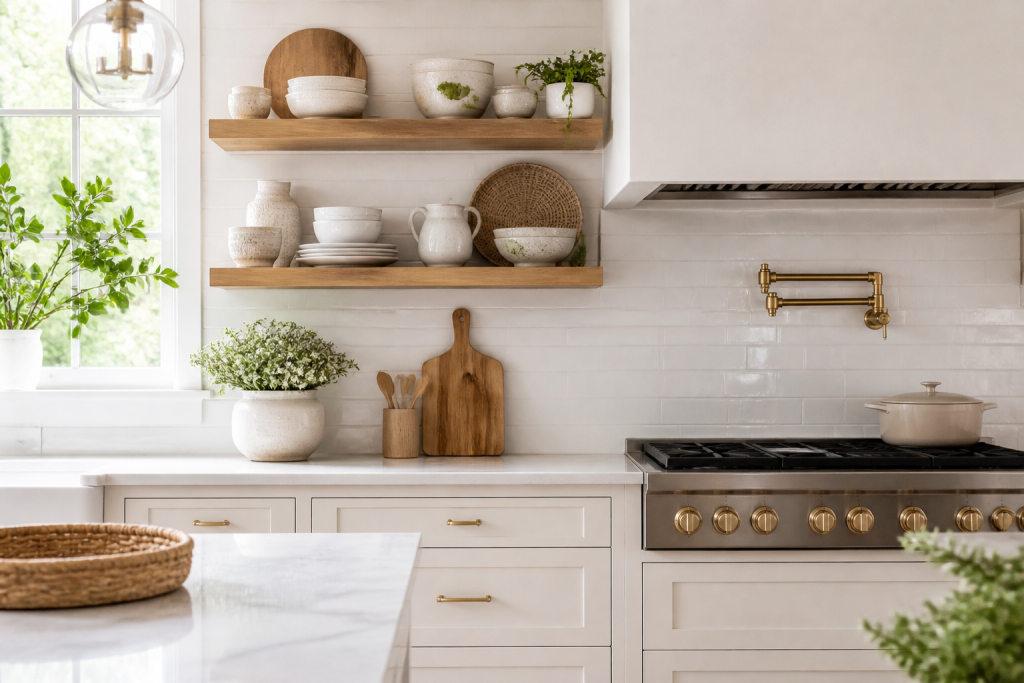
Walk into almost any kitchen built before the year 2000, and you will find the same thing: a wall of closed cabinetry, floor to ceiling, doors shut tight as if the dinnerware inside were a state secret. Somewhere along the way, we decided that the tools we use every single day should be hidden away, and that the space above our countertops should be reserved for boxes of cereal and mismatched Tupperware lids. The rise of floating shelves challenges that assumption — and it does so with good reason.
The choice between floating shelves and cabinets is not merely an aesthetic preference. It is a decision about how you move through your kitchen, how much you spend on your remodel, how often you clean, and how your space feels when you walk into it at 7 a.m. This article breaks down the trade-offs honestly, backs them with data and real-world examples, and makes the case that your dishes deserve an open display.
Why This Debate Matters More Than Ever
Kitchens have quietly become the most expensive room in the house to renovate, and storage is the single largest line item in most of those budgets. Industry remodeling reports routinely place the average major kitchen remodel somewhere between $25,000 and $30,000, with cabinetry accounting for roughly a third to half of that figure. When a single design decision can swing your budget by several thousand dollars, it deserves more than a passing thought.
At the same time, kitchen design has been drifting steadily toward openness. The same trend studies that track remodeling behavior — including Houzz's annual kitchen trends research and the National Kitchen & Bath Association's design surveys — have repeatedly shown open shelving appearing in a meaningful share of remodeled kitchens, generally in the range of one in five to one in four. It is not the dominant choice, but it is no longer a fringe one either.
The Case for Cabinets: What Closed Storage Gets Right
Before making the argument for shelves, it is worth being fair to cabinets. They earned their place.
- Concealment: Cabinets hide mismatched mugs, chipped bowls, and the blender you use twice a year.
- Dust and grease protection: Anything near a stovetop collects airborne cooking residue. Doors are a genuine barrier.
- High-density storage: A single tall cabinet can hold more than three or four shelves occupying the same wall space.
- Resale predictability: Buyers expect cabinets. Closed storage reads as "complete" to many people touring a home.
- Child and pet safety: Lockable doors keep sharp tools and glassware out of reach.
None of that is wrong. The problem is that cabinets are often used indiscriminately — deployed across entire walls regardless of what actually needs hiding, which is usually far less than we assume.
The Case for Floating Shelves: Light, Air, and Daily Access
Floating shelves — mounted directly to the wall with concealed brackets so no visible hardware interrupts the line — solve a different problem. They optimize for the things you touch every day.
- Immediate visibility: You can see every plate, glass, and bowl at a glance. No door, no rummaging, no forgotten items at the back.
- Ergonomic efficiency: Daily-use items sit in the natural reach zone. Cooking becomes a smoother sequence of movements.
- Visual lightness: Open shelves do not visually compress a room the way a solid block of cabinetry does. Small kitchens in particular feel dramatically larger.
- Cost efficiency: Per linear foot, quality shelving typically costs a fraction of custom cabinetry — often a third to a half, depending on materials.
- Personality: Shelves turn functional objects into decor. Handmade ceramics, copper pots, and glassware become part of the room's character.
There is also a psychological dimension worth naming. A kitchen where everything is behind a door subtly implies that the working state of the room is something to be hidden. A kitchen with open shelves treats cooking as a visible, ongoing, valued activity.
What the Data Says About Open Shelving
The research on open shelving is mostly behavioral rather than experimental, but the patterns are consistent across several sources:
- Trend surveys place open shelving in roughly 20–25% of renovated kitchens in recent years, with higher concentrations in smaller urban kitchens and in homes undergoing full "de-cabinetting" renovations.
- Storage audits conducted by professional organizers commonly find that 20–40% of items stored in kitchen cabinets go unused for a full year — meaning a significant portion of expensive closed storage is holding dead weight.
- Cost comparisons in remodeling data show that replacing an upper cabinet run with shelving can reduce that portion of the budget substantially, freeing funds for countertops, appliances, or lighting.
- Real estate observations suggest open shelving is polarizing: some buyers love it, others immediately calculate the cost of adding doors. This is a genuine consideration, not a myth.
The takeaway is not that shelves always win. It is that the default assumption — "cabinets everywhere, always" — is not supported by how people actually use their kitchens.
Floating Shelves vs. Cabinets: A Side-by-Side Comparison
- Cost: Shelves win, often decisively.
- Storage volume: Cabinets win, sometimes by a factor of two or more.
- Accessibility: Shelves win for daily items; cabinets win for occasional items.
- Cleanliness maintenance: Cabinets win. Open shelves require more frequent dusting and degreasing.
- Perceived space: Shelves win, especially in narrow or low-ceilinged kitchens.
- Visual calm: Cabinets win when the shelf contents are chaotic; shelves win when contents are curated.
- Resale flexibility: Cabinets win on average, though the gap narrows in design-forward markets.
Two Illustrative Case Studies
Case Study 1: The Galley Kitchen That Gained a Foot
Consider a representative scenario: a narrow 8-foot-wide galley kitchen in a city apartment, where the original design stacked uppers on both sides. The visual effect was a tunnel. The owners replaced one full run of upper cabinets with two floating shelves in a warm oak finish, keeping closed storage only on the opposite wall.
The measurable changes were modest but real: the room read as noticeably wider in photographs and in person, the most-used plates and glasses moved from a bending-and-reaching position to eye level, and the project came in well under the quoted cost of replacing the old cabinets. The trade-off was that the toaster and blender had to move to a lower cabinet, which required a small amount of daily bending — a fair exchange for the owners, who cooked at home most nights.
Case Study 2: The Family Kitchen That Went Hybrid
A second illustrative example: a family of five with a large suburban kitchen. They did not remove cabinets. Instead, they converted one 6-foot upper run adjacent to the sink into open shelving for everyday dishware, while keeping closed storage for everything else.
This hybrid approach is the most common successful outcome in real remodeling practice. The open section handles the high-frequency items — plates, bowls, glasses, mugs. The closed section absorbs the low-frequency, unattractive, and bulky items — serving platters, the stand mixer, kids' plastic cups, pantry overflow. The family reported that unloading the dishwasher became faster because the destination for most items was now directly in front of them.
The Honest Objections — and How to Solve Them
Dust and Grease
This is the most legitimate criticism. Open shelves near a cooktop will collect residue. The solution is placement: keep open shelving at least a few feet from the range, or restrict stovetop-adjacent shelving to items you wash frequently. A quick wipe-down of shelves during your normal kitchen cleaning takes seconds when nothing is behind a door.
Clutter and Visual Noise
Open shelving is unforgiving. Ten mismatched plastic containers will look worse on a shelf than behind a door. The fix is a curation rule: if it is not used weekly and does not look intentional, it does not belong on the shelf. Matching sets, consistent materials, and a limited color palette do most of the work.
Resale Value
Open shelving can be a sticking point for some buyers. If resale within a few years is likely, the hybrid approach is the safer play — it delivers the openness you want while preserving the closed storage volume a future buyer expects.
Design Rules for an Open Display That Actually Works
- Shelve only what you use weekly. Everything else belongs behind a door.
- Keep shelf depth between 8 and 12 inches. Deeper shelves invite clutter; shallower ones struggle to hold dinner plates.
- Leave breathing room. Empty space on a shelf is a design feature, not wasted storage.
- Group in odd numbers. Three stacks of plates or three vessels read as intentional; four often read as accidental.
- Mix heights and materials deliberately. A stack of plates, a small bowl, and a taller vessel create rhythm.
- Repeat one material or color. A single recurring element — wood, white ceramic, black metal — ties the display together.
- Anchor shelves into studs or proper blocking. A loaded shelf of stoneware is heavy. This is not a drywall anchor job.
The Hybrid Solution: The Best of Both Worlds
The most persuasive answer to "floating shelves or cabinets?" is usually "both, strategically." Closed storage is genuinely better for the 60–70% of kitchen items that are bulky, unattractive, or rarely used. Open shelving is genuinely better for the 30–40% of items that are beautiful, frequently used, or both. Design your storage around that split rather than around a default assumption, and the kitchen becomes both more functional and more enjoyable.
Final Thoughts: Your Dishes Are Not a Secret
The case for open display is ultimately about honesty and access. Your plates, bowls, and glasses are objects you touch multiple times a day; they are part of the rhythm of your home. Hiding them behind closed doors costs money, consumes visual space, and adds friction to the most repeated tasks in your kitchen.
That does not mean tearing out every cabinet. It means questioning the reflex to hide everything. Floating shelves are lighter on the wallet, lighter on the eye, and faster to use. Cabinets are better at concealment, volume, and protection. The smartest kitchens use both — shelves for the dishes you love and use, cabinets for everything else.
So start with one wall. Move your everyday dishware into the open, keep the rest behind doors, and live with it for a month. Most people find that the shelf they were nervous about becomes the part of the kitchen they like most — not because it looks styled, but because it works.