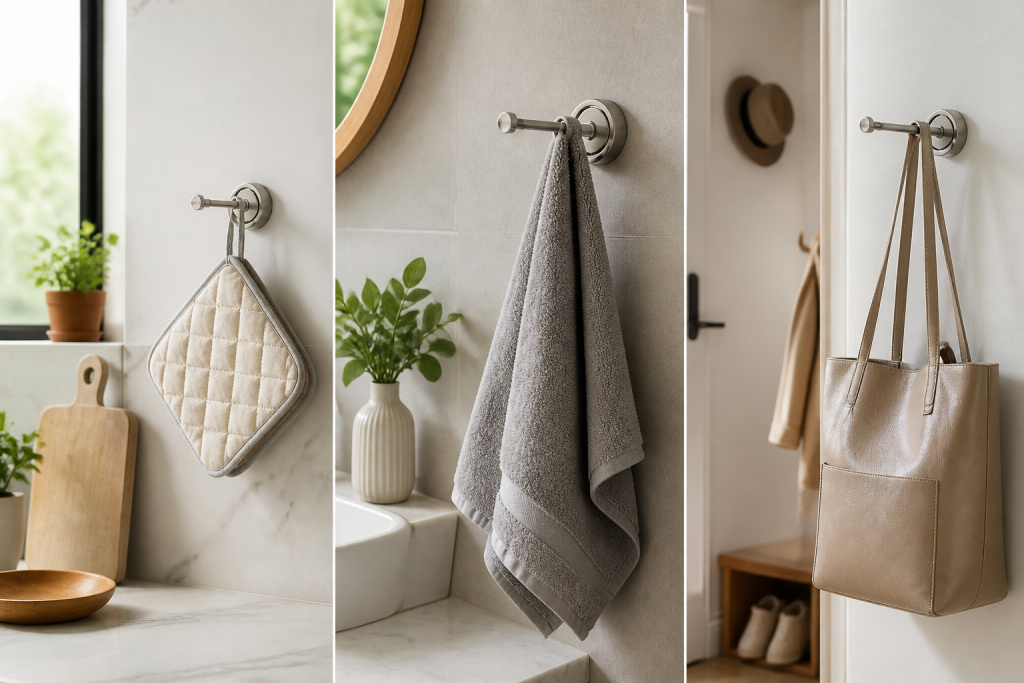
A retractable wall hook looks like a small, unremarkable piece of hardware—until you live with one. Then you notice how much a single folding hook can change the way a narrow galley kitchen, a steamy bathroom, or a cluttered entryway actually functions. Unlike a fixed hook that juts out permanently and snags sleeves, bags, and hips, a retractable hook folds flat against the wall when it isn't carrying anything, then swings or pulls out the moment you need it.
The problem is that the category has exploded. Search any marketplace and you'll find hundreds of near-identical listings with wildly different load ratings, materials, and mounting systems—often priced between $6 and $60 for what looks like the same product. Choose badly and you get a hook that sags under a wet towel, rusts within a season, or rips a two-inch crater out of your drywall. Choose well and you get a decade of quiet, invisible utility.
This guide walks through the specifications that genuinely matter, then applies them room by room, because a hook that's perfect beside a kitchen sink is often the wrong hook for a humid bathroom or a busy entryway.
What Exactly Is a Retractable Wall Hook?
Retractable hooks (sometimes sold as "folding hooks," "pop-out hooks," or "hidden hooks") use one of three mechanisms to stow the hook arm flat:
- Spring-loaded push hooks: Press the arm and it pops out; press it again and it locks flush. These are the most common and typically handle 5–15 lbs.
- Swivel or pivot hooks: The arm rotates 90 degrees on a hinge. Simple, durable, and usually the strongest option, often rated 15–35 lbs.
- Magnetic or clip-retained hooks: A magnet or friction clip holds the arm flat. Elegant and silent, but the retention can weaken over years of use.
Fixed hooks are cheaper and simpler. So why bother with a mechanism that can fail? Because the failure point of a fixed hook isn't the hardware—it's your shin, your sweater, and the visual clutter of a dozen permanent protrusions. In tight spaces, retractability isn't a gimmick; it's the feature that lets you install more hooks than you otherwise could.
Why Retractable Hooks Are Having a Moment
Small-space living has become the default for a huge share of households. U.S. Census Bureau data on newly completed apartments has hovered around a median of roughly 900–1,000 square feet for years, and in expensive metro markets the average is considerably lower. When square footage is scarce, vertical storage stops being optional.
There's also a hygiene angle that gets overlooked. Damp towels left bunched on a bar or a fixed hook dry slowly, and slow drying is what feeds mildew. Hooks that hold fabric open and allow airflow—combined with the ability to fold the hardware away so the wall itself can dry—measurably improve how quickly items dry. That's a small thing that compounds daily.
The Seven Specifications That Actually Matter
1. Load Rating—and How It's Mounted
A "20 lb" rating means nothing if the hook is attached with a 3M-style adhesive strip rated for 5 lbs. Always read the rating as a system: hook capacity and mounting method. As a rule of thumb, adhesive mounting caps out around 5–8 lbs per hook in ideal conditions, screw-and-anchor mounting handles 15–35 lbs, and screw-into-stud mounting can exceed 50 lbs.
2. The Retraction Mechanism
Spring-loaded hooks feel satisfying but have more moving parts. Swivel hooks are mechanically simpler and generally last longer. If the hook will be operated dozens of times a day—say, in an entryway—prioritize the swivel design. If it will sit extended for weeks at a time holding a bathrobe, the mechanism barely matters.
3. Material and Finish
- 304 stainless steel: The gold standard for bathrooms and kitchens. Resists corrosion, holds a load, and looks good for years.
- Zinc alloy with plating: Common and affordable. Chrome and nickel finishes perform well; cheap painted finishes flake.
- ABS plastic: Fine for lightweight keys and small towels, but UV and heat degrade it over time.
- Aluminum: Light, rust-proof, but softer—avoid for heavy loads.
4. Hook Shape and Depth
A shallow hook drops things. A deep hook with a pronounced upturn holds a bag strap securely. For entryways, look for a hook depth of at least 1.5 inches with a rounded, upturned tip so straps don't slide off. For bathrooms, a broader, flatter hook prevents towel creasing.
5. Mounting Hardware
Screws and wall anchors give you reliability. Adhesive gives you damage-free installation—genuinely useful for renters—but requires a clean, smooth, painted surface and 24 hours of cure time before loading. Magnetic mounting only works on steel doors and appliances, and it's best reserved for lightweight items.
6. Number of Hooks and Spacing
Multi-hook rails are efficient, but spacing matters. Allow at least 3–4 inches between hook centers so wet towels and bulky coats can actually dry and hang without pressing against each other. Many budget rails space hooks only 2 inches apart, which looks tidy in photos and frustrates you in practice.
7. Aesthetics and Finish Coordination
Hardware is visible, even when folded. Matte black and brushed nickel remain the most versatile finishes. If you're installing a row of hooks, buy them all at once—finish batches vary, and a mismatched matte black is glaringly obvious in daylight.
Kitchen: Surviving Grease, Heat, and Real Weight
The kitchen is where retractable hooks earn their keep, because the items you hang there are the bulkiest and heaviest in the house.
- Aprons and oven mitts: 0.5–1.5 lbs—any hook works.
- Cast iron skillets: 5–10 lbs each—requires screw mounting into a stud or a heavy-duty toggle anchor.
- Stockpots and pans: 3–8 lbs—same requirement.
- Grocery tote bags: 1–3 lbs empty, far more when loaded.
Case study: A reader's narrow galley kitchen had 26 inches of usable wall between the range and the fridge. A fixed rail of four hooks made the walkway feel like an obstacle course. Switching to four spring-loaded stainless hooks—mounted with toggle bolts into the stud line above the counter—reclaimed the clearance entirely, and the family now hangs two skillets, an apron, and a pair of oven mitts there. The total cost was under $35.
Kitchen buying priorities: stainless steel or nickel-plated zinc, screw mounting, 15 lb minimum rating, and a hook depth of at least 1.5 inches. Skip adhesive here—steam and grease degrade adhesive bonds faster than almost anywhere else in the home.
Bathroom: Fighting Moisture, Mildew, and Soggy Towels
Humidity is the enemy. A bathroom hook faces condensation, splashes, and constantly wet fabric, which is why the cheapest chrome-plated hooks start pitting within a year in poorly ventilated bathrooms.
Weight math matters more than people expect. A dry bath towel weighs roughly 1–1.5 lbs; soaked, it can reach 2.5–3 lbs. A wet bathrobe can hit 4–6 lbs. If you hang a wet towel and a wet robe on a shared multi-hook rail, you're asking that rail to hold 8–9 lbs continuously—while damp.
- Best pick: 304 stainless steel swivel hooks rated 10–15 lbs, screw-mounted.
- Finish: Brushed nickel or stainless hides water spots far better than polished chrome.
- Avoid: Adhesive mounts on tile behind a shower—grout lines, steam, and soap film are a bad combination.
- Smart extra: Install one hook per family member at staggered heights (children lower, adults higher) so towels aren't stacked.
Entryway: The Highest-Traffic Zone in the House
Entryways demand the most from hooks and are the most likely to be overloaded. A loaded backpack runs 5–15 lbs. A winter coat is 3–5 lbs. A tote full of groceries can hit 20 lbs. Multiply that by a family of four and you're looking at 40–60 lbs spread across a wall.
Case study: A family of five used a single rail of six adhesive hooks by the front door. Within three months, two hooks had pulled free and taken paint with them. The fix was a swivel-hook rail fastened into two studs with 2.5-inch screws, plus a separate low rail at 36 inches for the two youngest children. Total hardware cost: about $45. The wall has held for four years since.
Entryway buying priorities: swivel mechanism, 15–25 lb rating, screw-and-stud mounting, deep upturned hook tips, and at least 4 inches of spacing. Add a small shelf or a key tray above the rail to keep light items off the hooks.
Installation Tips That Prevent Costly Mistakes
- Find the studs first. A $15 stud finder prevents a $200 drywall repair.
- Match the anchor to the wall. Toggle bolts for hollow drywall with heavy loads; self-drilling anchors for plaster; never rely on a plain plastic plug for anything over 10 lbs.
- Drill tile with a carbide or diamond bit at low speed. Use masking tape over the drill point to stop the bit wandering.
- Let adhesive cure fully. Most adhesive hooks specify 24 hours before loading—and they mean it. Loading early is the number one cause of adhesive failure.
- Set the height deliberately. Coat hooks at 66–72 inches, towel hooks at 48–60 inches, kids' hooks at 36–42 inches.
- Pre-drill pilot holes. It prevents splitting in wood and keeps hardware from twisting.
Common Mistakes to Avoid
- Buying on load rating alone without checking the mounting method.
- Using adhesive hooks for wet towels, coats, or anything over 5 lbs.
- Installing hooks so close together that nothing dries.
- Choosing polished chrome for a humid bathroom.
- Mounting directly into drywall with no anchor and hoping for the best.
- Mixing finishes from different batches on the same wall.
Budget Guide: What Should You Actually Pay?
- Under $10: Plastic or thin zinc hooks, adhesive-mounted. Fine for keys, lightweight hand towels, and rentals.
- $10–$25: The sweet spot. Stainless or quality zinc, screw-mounted, 10–20 lb ratings, single or double hooks.
- $25–$60: Multi-hook rails, designer finishes, higher load ratings, and better tolerances on the retraction mechanism.
Spending $20 instead of $8 usually buys you ten more years of service. In a high-traffic entryway or a humid bathroom, that math is easy.
A Quick Decision Framework
- Kitchen: Stainless, screw-mounted, 15 lb+, deep hook, 1.5-inch minimum depth.
- Bathroom: 304 stainless, brushed finish, swivel mechanism, 10–15 lb, one hook per person.
- Entryway: Swivel, 15–25 lb, stud-mounted, wide spacing, kid-height rail for children.
- Rental or temporary: Adhesive only for items under 5 lbs, on smooth painted surfaces, cured 24 hours.
Final Thoughts: Buy for the Load, Not the Look
The best retractable wall hook is the one that disappears when you don't need it and holds firmly when you do. That outcome depends on four decisions made in the right order: choose the mechanism based on how often you'll operate it, choose the material based on how humid the room is, choose the mounting method based on how heavy the load will be, and choose the finish last, once the functional specs are locked in.
Apply that sequence and the room-specific rules follow naturally. Kitchens need stainless steel and screw mounting to survive grease, heat, and cast iron. Bathrooms need corrosion-resistant hardware and generous spacing so wet fabric can actually dry. Entryways need swivel mechanisms, stud-anchored rails, and enough hooks that nobody has to double up. Get those three right—and resist the temptation to save eight dollars on hardware that will fail under a wet towel—and you'll have solved a small, daily annoyance for the next decade.