Few patterns divide a room quite like zebra print. To some, it is the ultimate shorthand for glamour — a stripe of wildness in an otherwise neutral wardrobe. To others, it still carries the faint whiff of a 1980s power suit or a budget Halloween costume. The truth, as any stylist will tell you, sits somewhere in between: zebra print is one of the most versatile, forgiving, and quietly sophisticated patterns available, provided you understand a few rules about scale, texture, and restraint.
Unlike leopard or cheetah, zebra print is inherently monochrome. There is no caramel, no tawny brown, no rust — just black and white, or black and cream. That single fact is why it plays so well with almost any colour palette and why it has survived decade after decade of trend cycles. This guide breaks down everything you need to know about zebra print fabric: what it is, how it behaves on different textiles, how to wear it without looking costumed, and how to bring it into your home without turning your living room into a safari tent.
Why Zebra Print Works: The Power of Black and White
The staying power of zebra print comes down to three practical advantages that coloured animal prints simply cannot match.
- It is infinitely combinable. Because zebra stripes contain no colour, they function almost like a neutral. A zebra-print skirt works with red, cobalt, mustard, olive, pastel pink, or head-to-toe black. Try that with a brown leopard print and you will find your options considerably narrower.
- It creates optical movement. The high contrast between black and white draws the eye and creates a sense of dynamism. Designers use this deliberately — vertical zebra stripes can elongate a silhouette, while diagonal or irregular stripes create a flattering sense of motion across the body.
- It photographs beautifully. In an era when personal style is documented constantly, monochrome patterns hold their definition under almost any lighting. Coloured prints can turn muddy in low light; black and white rarely does.
Animal prints have remained a fixture on runways for decades, appearing in collections from houses such as Roberto Cavalli, Dolce & Gabbana, and Saint Laurent, and reappearing in mainstream retail almost every autumn/winter season. Fashion search platforms routinely report spikes in searches for "animal print" during September and October, when transitional dressing sends shoppers looking for a pattern that works with both light summer layers and heavy winter coats. Zebra print sits at the centre of that trend because it is the most seasonless of the family.
Know Your Zebra: A Quick Guide to Print Variations
"Zebra print" is not one single design. Before you buy, identify which variation you are actually looking at, because each behaves differently on the body.
- Classic natural zebra: Fine, dense, slightly irregular stripes in true black on white. Elegant but busy — best in small doses or on flowing fabrics.
- Oversized or abstract zebra: Thick, painterly stripes with wide spacing. This is the most modern and most flattering option, because the eye reads it as a graphic print rather than a literal animal skin.
- Watercolour or blurred zebra: Soft-edged stripes that fade into cream and grey. Softer and more romantic, ideal for silk and chiffon.
- Mini or micro zebra: Very small stripes that read almost as a texture from a distance. Excellent for shirts, blouses, and accessories.
- Two-tone variants: Navy and white, cream and brown, or grey and black. These soften the contrast and can be easier to wear for those who find pure black-and-white too stark.
- Metallic or flocked zebra: Stripes rendered in gold foil, velvet flocking, or devoré. Statement pieces, best worn alone.
The Golden Rules of Styling Zebra Print
Rule 1: Balance Boldness with Restraint
The most common styling error is treating zebra print as a background rather than a focal point. If your zebra piece is loud — an oversized coat, a maxi dress, wide-leg trousers — everything else in the outfit should be quiet. Pair a zebra coat with a plain black turtleneck, straight-leg denim, and minimal jewellery, and the coat does all the talking. Pair the same coat with a floral blouse, a printed bag, and statement earrings, and the outfit collapses into visual noise.
Rule 2: Match the Scale to the Garment
Scale matters enormously. Large, widely spaced stripes suit large surface areas: coats, maxi skirts, wide-leg trousers, and dresses. Fine stripes suit small surfaces: blouses, shirts, pencil skirts, and accessories. A tiny micro-zebra print stretched across a floor-length coat can look like static from a distance, while giant stripes on a fitted top can overwhelm the wearer's frame.
Rule 3: Anchor with Solids
Treat zebra print as the seasoning, not the meal. A reliable formula is one zebra piece plus two solid pieces in complementary tones. Black, white, cream, and grey are the obvious anchors, but deep green, burgundy, and electric blue create more interesting results and prevent the outfit from reading as generic monochrome.
Rule 4: Play with Texture
Because zebra print is already visually busy, texture is your best tool for adding depth without adding pattern. Combine a zebra-print silk skirt with a chunky cable-knit sweater, or zebra-print leather boots with tailored wool trousers. The contrast between smooth and rough, matte and shiny, keeps the outfit interesting without introducing competing prints.
Zebra Print by Fabric Type
The fabric a zebra print is printed on changes its personality entirely. Here is how the most common options behave.
- Silk and satin: Fluid, reflective, and luxurious. Best for slip dresses, blouses, and scarves. The sheen makes stripes appear to shift as you move, which is flattering but unforgiving of poor fit.
- Cotton and poplin: Crisp and casual. Ideal for shirts, shirt dresses, and summer trousers. Holds a sharp, graphic look and is the easiest entry point for zebra-print beginners.
- Jersey and ponte: Stretchy and body-hugging. Best for midi dresses and leggings. Choose an oversized or abstract stripe here, as fine stripes on stretch fabric can distort across curves.
- Velvet and devoré: Deeply textural and evening-appropriate. A zebra-print velvet blazer is one of the most reliable party pieces you can own.
- Denim and canvas: Sturdy and casual. Zebra-print denim jackets and tote bags read as playful rather than glamorous.
- Knitwear: Intarsia or jacquard zebra knits are softer and more subtle than printed versions, making them ideal for daytime.
Building Outfits: A Zebra Print Lookbook
Everyday Casual
Start with a fine-stripe zebra blouse in cotton, tucked into straight-leg blue jeans. Add white sneakers and a black leather shoulder bag. The print lifts an otherwise ordinary jeans-and-a-top combination without requiring any effort.
Smart Casual and Office
A zebra-print midi skirt in a matte fabric, worn with a plain black fine-knit sweater and loafers, is polished enough for most modern workplaces. Keep the stripe scale medium and the colour palette strictly black, white, and one accent.
Evening
An oversized zebra-print satin slip dress, black strappy heels, and a single bold earring. Resist the urge to add a printed clutch — a plain black box bag is the correct choice here.
Street Style and Festival
This is where you can break the rules. Zebra-print wide-leg trousers with a graphic tee, chunky boots, and a cropped denim jacket creates the kind of high-low mix that street style photographers gravitate toward. Layering zebra with other black-and-white patterns — a small polka dot or a fine stripe — works here because the shared monochrome palette holds everything together.
Zebra Print in the Home
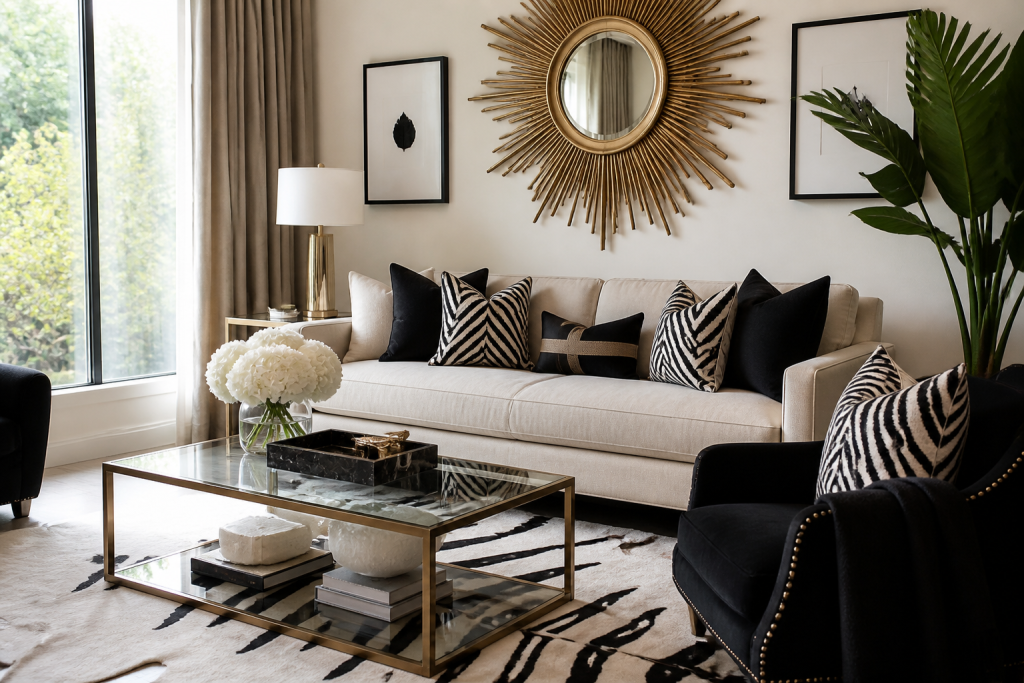
Zebra print translates surprisingly well to interiors, largely because black and white is already a staple of modern design. A zebra-print rug anchors a neutral living room without committing to colour. Zebra-print cushions add interest to a plain linen sofa. Upholstering a single occasional chair in zebra velvet creates a focal point that costs far less than redoing a whole room. The same rule applies indoors as outdoors: one statement piece per room, surrounded by solids.
Common Mistakes to Avoid
- Wearing zebra head to toe. Unless you are deliberately going for a maximalist editorial look, two zebra pieces in one outfit is usually one too many.
- Mixing zebra with other animal prints. Zebra and leopard together rarely works; the two compete rather than complement.
- Ignoring your undertone. Pure black-and-white can be harsh on very warm or very fair complexions. Cream-and-black or grey-and-black variants are gentler alternatives.
- Buying cheap printed polyester. Low-quality digital printing can look flat and slightly blurred. Look for clear, crisp stripe edges.
- Forgetting proportion. A zebra-print coat over a zebra-print dress is a costume. A zebra-print coat over black tailoring is a statement.
Case Study: A Capsule Wardrobe Built Around One Zebra Piece
Consider a composite example that stylists use frequently in client work. A shopper buys a single oversized zebra-print blazer in a cream-and-black abstract stripe. Over one season, she builds six distinct outfits from it: over a white T-shirt and jeans for weekends; over a black slip dress for evening; with tailored black trousers and a silk camisole for work; over an all-cream outfit for a summer event; with burgundy knitwear and dark denim in autumn; and belted as a dress with opaque tights in winter. The blazer cost roughly the same as three mid-range tops, but it generated more outfit combinations than anything else in her wardrobe. That is the real argument for zebra print: a single well-chosen piece has an outsized return on investment because it pairs with everything already hanging in your closet.
Care and Longevity
Zebra print tends to show wear more visibly than solid fabrics, because fading or pilling disrupts the crispness of the stripe. Wash printed garments inside out in cold water, avoid harsh detergents, and dry flat or on a low setting. Silk and velvet zebra pieces should be dry-cleaned. Store knitwear folded rather than hung to prevent the shoulders from stretching and distorting the pattern.
Key Takeaways
Zebra print is one of the most wearable patterns in fashion precisely because it is not colourful. Its black-and-white palette makes it behave like a neutral, allowing it to slot into wardrobes built around almost any colour scheme, while its graphic quality delivers instant visual interest. The professionals' approach comes down to four principles: let one zebra piece be the focal point, match the stripe scale to the size of the garment, anchor the look with solid colours and interesting textures, and choose the fabric as carefully as the print. Get those four things right, and zebra print stops being a costume and becomes what it has always been at its best — a confident, endlessly versatile classic that works on a blouse, a boot, a blazer, or a rug with equal ease.