Walk into most bathrooms built in the last thirty years and you will see the same trio: a white porcelain sink, a beige or gray vanity, and a mirror that could have been purchased in any decade. These rooms function perfectly well, but they rarely say anything. They are rooms of utility rather than rooms of character.
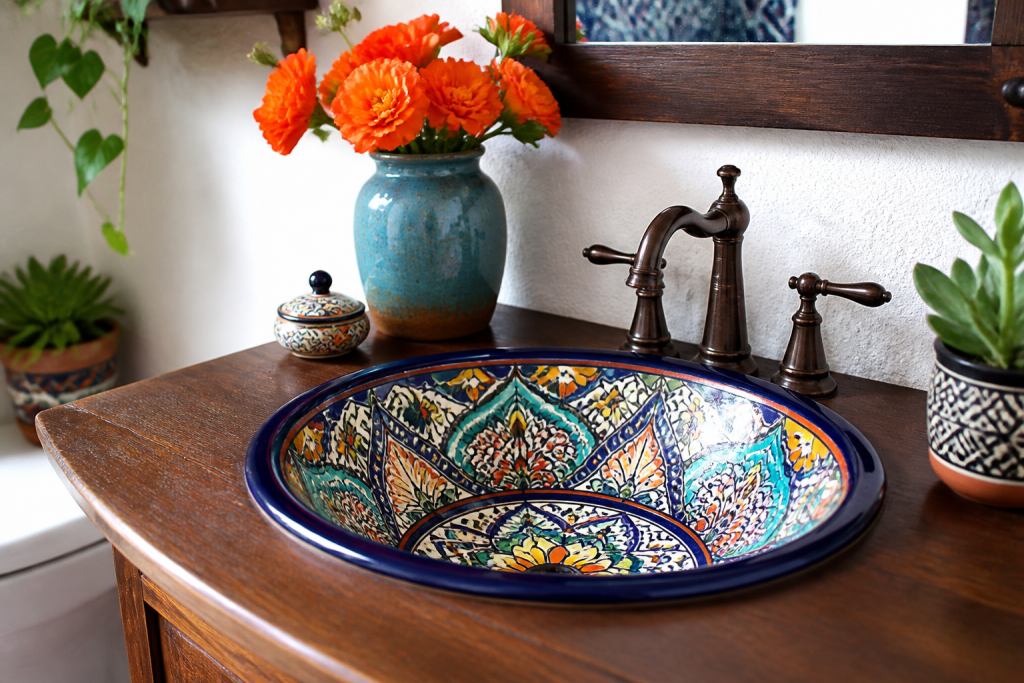
A hand-painted Talavera bathroom sink changes that equation in a single stroke of cobalt blue. It is one of the few fixtures you can install that carries centuries of craft history, visible human brushwork, and enough color to anchor an entire design scheme. For homeowners tired of builder-grade sameness, it is arguably the highest-impact, lowest-square-footage upgrade available.
This article explores what a genuine Talavera sink is, how it is made, why it works so well as a focal point, and what you need to know before you buy one.
What Exactly Is a Talavera Bathroom Sink?
Talavera is a style of Mexican majolica pottery named after the Spanish city of Talavera de la Reina, where the technique originated. When Spanish potters arrived in Puebla, Mexico, in the sixteenth century, they brought European tin-glazing methods with them. Those methods merged with indigenous Mexican clay-working traditions and, later, with design influences from Chinese porcelain arriving via the Manila galleon trade. The result was something entirely new: a distinctive blue-and-white, richly patterned ceramic that became a signature of Puebla's artisan districts.
The craft is formally protected. The Mexican government granted Talavera pottery a Denominación de Origen (designation of origin) in 1995, restricting the name to certified workshops in specific regions of Puebla and Tlaxcala. In 2019, UNESCO inscribed the artisanal Talavera of Puebla and Tlaxcala on its Representative List of the Intangible Cultural Heritage of Humanity, recognizing both the technique and the community of artisans who keep it alive.
What distinguishes a genuine Talavera sink from a mass-produced "Talavera-style" one comes down to a handful of markers:
- Regional origin: Authentic pieces are made in certified workshops in Puebla or Tlaxcala, Mexico, not in factories elsewhere.
- Hand-thrown or hand-formed clay: The body is shaped by hand or on a potter's wheel, which is why no two are perfectly identical.
- Tin-based glaze: The milky white background comes from a tin glaze, not a modern opaque enamel.
- Freehand painting: Designs are applied with a brush by a trained decorator, not stamped or transferred by machine.
- Two firings: The piece is fired once for the clay body and again after glazing and painting.
- Signature or workshop mark: Certified pieces typically carry the workshop's mark, and often the artisan's initials.
That last point matters enormously in the marketplace. A large share of sinks sold online as "Talavera" are imitation ceramics produced in high-volume factories and painted with simplified patterns. They can still be attractive, but they are not the same object, and they will not age the same way.
The Craft Behind the Color: How a Talavera Sink Is Made
Understanding the process explains why these sinks look and feel different from anything produced on an assembly line.
From Clay to Kiln
The work happens in stages, and each stage is handled by a specialist:
- Forming: The sink body is shaped from a blend of local clays, then dried slowly to prevent cracking.
- First firing: The unfired piece goes into the kiln at roughly 850–900°C, hardening the body into a porous "bisque."
- Glazing: The bisque is dipped or coated in a tin glaze that will become the glossy white canvas.
- Painting: A decorator applies the design freehand using mineral pigments — most famously cobalt blue, but also yellow, green, orange, and black. This is where the human hand becomes visible, in slightly varied line weights and tiny asymmetries.
- Second firing: The painted piece is fired again at around 1,000–1,100°C, fusing pigment and glaze into a single durable surface.
Because of the drying and firing cycles, a single sink can take three to six weeks from raw clay to finished product. That timeline is one reason authentic pieces cost more — and one reason they feel like heirlooms rather than purchases.
Why a Talavera Sink Works So Well as a Statement Piece
Color and Pattern No Mass-Market Sink Can Match
Most bathroom fixtures are designed to disappear. A Talavera sink is designed to be seen. The saturated glazes and repeating geometric or floral motifs introduce color at eye level, in the exact spot where a guest's gaze naturally lands. Designers often describe the sink as the "jewelry" of a bathroom, and Talavera is the closest thing to a statement necklace in fixture form.
Handmade Imperfection as a Design Feature
In an era when nearly everything in a home is machine-perfect, subtle irregularity reads as luxury. Slight variations in the painted line, a glaze that pools a little differently in one corner, a rim that isn't perfectly uniform — these are the fingerprints of the maker. They are also why two sinks from the same workshop will never be identical, which appeals strongly to homeowners who want a room that cannot be replicated from a catalog.
A Focal Point That Anchors the Whole Room
The practical design benefit is that a Talavera sink makes the rest of the decisions easier. Once the sink establishes a palette — say, cobalt and white with terracotta accents — the vanity finish, wall color, hardware, and mirror frame all have a reference point. Rather than starting from a blank white canvas, you are designing around a centerpiece.
Design Ideas: Where Talavera Sinks Shine
These sinks are remarkably adaptable, but they perform best in specific contexts:
- Powder rooms: Small, high-visibility, and low-moisture. A powder room is the ideal debut for a bold Talavera sink because guests see it, but it doesn't have to survive daily showers.
- Guest bathrooms: A single dramatic sink gives a guest bath a boutique-hotel feel without a full renovation.
- Primary bathrooms with a warm palette: Paired with natural wood, unlacquered brass, and warm white walls, a Talavera sink feels collected rather than themed.
- Southwestern, Mediterranean, and Spanish Colonial homes: The style is a natural architectural fit and reads as authentic rather than applied.
- Coastal and cottage interiors: A blue-and-white pattern bridges beautifully with white shiplap, linen, and rattan.
- Pool baths and casitas: Durable fired ceramic handles humidity well and adds personality to spaces that are often treated as afterthoughts.
Consider a representative example: a homeowner with a standard 5-by-8-foot guest bathroom, white subway tile, and a plain oak vanity. Rather than replacing the tile or vanity, they swap in a 17-inch oval Talavera sink with a cobalt floral pattern, add a matching hand-painted tile backsplash, and change the faucet to antique brass. Total material cost: a few hundred dollars. The room reads as fully redesigned, because the eye is now drawn to a single intentional focal point instead of scanning a field of neutral surfaces.
That pattern — one strong element, everything else quiet — is the most reliable way to use a Talavera sink successfully. Fighting it with competing patterns usually produces visual noise.
Practical Considerations Before You Buy
A Talavera sink is a ceramic fixture, so installation and care require a little more attention than a standard porcelain basin.
Sizing and Installation
- Measure your vanity cutout first. Common sizes include 16-by-16-inch squares, 17-by-14-inch ovals, and 19-by-16-inch rectangles, but handmade pieces vary slightly.
- Confirm the drain size. Most take a standard 1¾-inch drain assembly.
- Check faucet drilling. Options are typically no drilling (for vessel or wall-mounted faucets), single-hole, 4-inch centerset, or 8-inch widespread. Order the drilling to match your faucet, not the other way around.
- Plan for weight and support. Ceramic sinks are heavy, and a fully loaded vanity needs adequate framing. Undermount installations require a solid surface and careful support.
- Verify lead-free compliance. Some traditional glazes historically contained lead. Any sink intended for use as a functioning washbasin should be certified lead-free for plumbing use — always ask the seller directly.
Caring for a Hand-Painted Sink
With reasonable care, a fired and glazed ceramic sink can last decades — often thirty years or more.
- Clean with mild dish soap, warm water, and a soft cloth or sponge.
- Avoid abrasive powders, steel wool, and scouring pads, which dull the glaze.
- Avoid harsh acidic or bleach-heavy cleaners that can etch the surface over time.
- Don't leave standing water or strongly colored liquids sitting in the basin.
- Avoid thermal shock — never pour boiling water into a cold sink.
- Use a drain strainer to catch debris and prevent chips from dropped objects.
The Investment Case: Cost, Value, and Longevity
Pricing for hand-painted Talavera sinks generally falls into these ranges:
- $150–$400: Smaller drop-in sinks, often from mid-sized workshops or imported reproductions.
- $400–$900: Standard-size sinks from established Puebla or Tlaxcala workshops with detailed freehand decoration.
- $900–$2,500+: Large, complex, or custom-commissioned pieces, sometimes paired with matching tile.
Compare that to the cost of a full bathroom renovation, and the value proposition becomes clear. Industry cost-versus-value studies have consistently found that midrange bathroom remodels recoup roughly 60–70% of their cost at resale. But a sink swap is not a remodel — it is a cosmetic upgrade that costs a fraction of one and delivers a disproportionate share of the visual impact. If you are not ready to gut the room, changing the sink is one of the most efficient ways to change how the room feels.
There is also a durability argument. A well-made ceramic sink does not peel, fade, or delaminate the way some composite and enamel-over-metal basins do. Its decorative surface is fused into the glaze, not applied on top of it.
Sustainability and Craft: The Story You Are Actually Buying
Buying from a certified workshop means supporting a craft economy that has survived for roughly five centuries. Many Puebla and Tlaxcala workshops are family operations that train apprentices over years, and the UNESCO designation was created in part to protect that knowledge transfer. When you buy a genuine hand-painted piece, a meaningful share of your money goes to a human being with a brush rather than to a factory mold.
There is also an environmental angle worth noting: fired clay is an inert, long-lasting material. A sink that lasts thirty years and never needs replacing avoids the manufacturing and shipping footprint of three or four short-lived replacements.
How to Spot a Genuine Hand-Painted Talavera Sink
Before you buy, run through this checklist:
- Does the seller name the specific workshop and region (Puebla or Tlaxcala)?
- Is the piece signed or marked by the workshop?
- Can the seller show photographs of the actual individual sink, not just a stock image?
- Are the painted lines slightly varied in thickness, as brushwork would be?
- Is the price suspiciously low for the size and complexity of the pattern?
- Is the sink certified lead-free for plumbing use?
- Does the seller explain the firing process and the two-fire method?
If a listing cannot answer most of these, assume you are looking at a decorative reproduction rather than an authentic piece.
Final Thoughts: One Fixture, Entirely Different Room
A hand-painted Talavera bathroom sink is not the cheapest way to update a bathroom, but it may be the most efficient. It delivers color, pattern, texture, and cultural depth in a single object, at a cost far below a full renovation and with a lifespan measured in decades. It transforms the sink — the most utilitarian object in the room — into the reason the room exists.
The key takeaways are straightforward. First, authenticity matters: genuine Talavera comes from certified workshops in Puebla and Tlaxcala, is shaped and painted by hand, and is fired twice using traditional tin-glaze methods. Second, function matters: verify sizing, drain and faucet drilling, lead-free certification, and installation support before you commit. Third, design discipline matters: let the sink be the star and keep everything around it calm, so the pattern reads as intentional rather than chaotic. Finally, care matters: mild soap, soft cloths, and a drain strainer will keep the glaze and the painted detail vibrant for decades.
If your bathroom feels like every other bathroom you have ever walked into, you do not necessarily need a remodel. You need a focal point. A hand-painted Talavera sink is one of the few upgrades that adds craft, story, and color in the same motion — and it will still be beautiful long after the paint colors you chose around it have gone out of style.